
Beef Businesses Bleeding: Who Profits From the Reference Price Policy? By Khudori

Smallest Font
Largest Font
PONDOKGEDE Indonesia,NETTInpo. Com
The government’s decision to raise the reference purchase price for live cattle at the producer level to Rp59,000/kg live weight, announced by Coordinating Minister for Food Zulkifli Hasan on April 22, 2026, has instead battered cattle fattening businesses (feedlots) and the entire fresh beef supply chain.
The new price remains below the cost of goods sold (COGS), which reaches Rp64,000–Rp70,000/kg after raising imported Australian cattle for 100 days. The squeeze stems from feeder cattle prices now at US$4.32/kg and a weaker rupiah.
Feedlot operators who imported feeder cattle from Australia three months ago at US$3.8/kg have been losing money for months. Their COGS now stands at Rp65,000/kg, while the consumer-level reference price for fresh beef remains capped at Rp130,000–Rp140,000/kg under Bapanas Regulation No. 12/2024.
During the April 20, 2026 Inflation Coordination Meeting, Makmun, Director of Livestock Product Downstreaming at the Ministry of Agriculture, said Australian male feeder cattle now cost US$4.32/kg. With insurance and quarantine, the landed cost in Indonesia hits Rp77,177/kg. Feedloters proposed Rp65,000/kg and Bapanas suggested Rp62,612/kg, but both were rejected. Forced to cut feed costs, operators now see carcass yields drop to 50% and meat yield at just 65–70% of carcass weight.
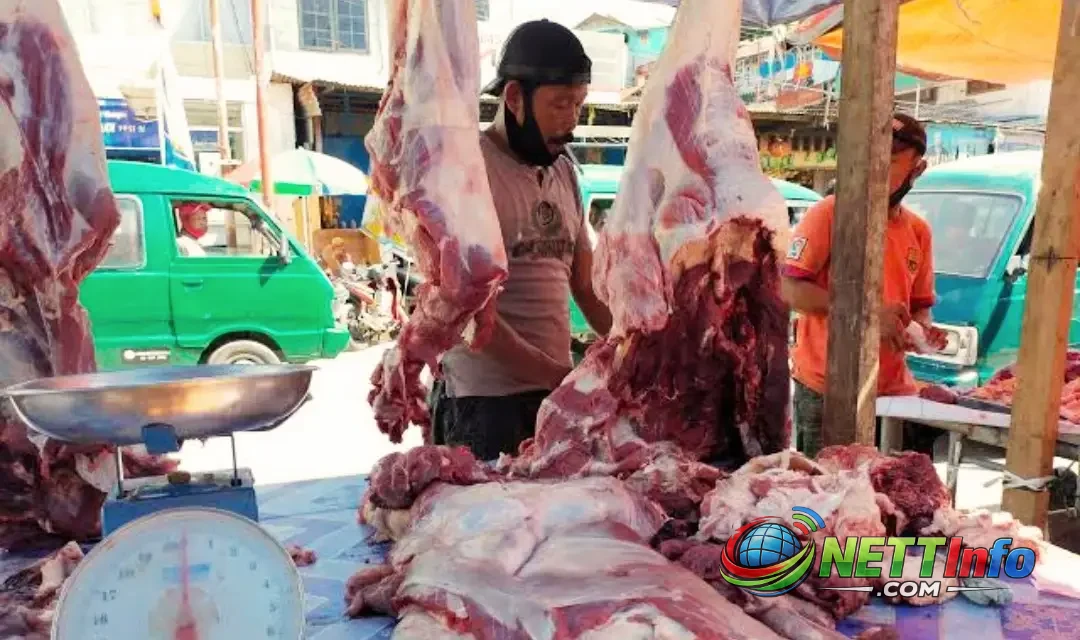
Traders at slaughterhouses, butchers, and beef retailers are also taking losses. Thin margins fail to cover transport costs and weight loss from cattle stress. Fresh beef prices in markets on April 23, 2026 stood at Rp138,961/kg, complying with the reference price. But low meat yields are making operations “bleed.”
Private imports reached only 71,335 head as of April 17 out of a 600,000 head quota. Fresh beef supply could fall and prices rise if not offset by local cattle, which cover 65.4% of 2025 demand, or by frozen meat.
Who Profits? Frozen Meat SOE Importers
Importers of frozen beef and buffalo meat, such as PT Berdikari for Indian buffalo and PT PPI, face no rearing risks. The 2026 import quota totals 297,000 tons, dominated by SOEs at 270,000 tons, or 61.7%. Private firms get only 30,000 tons.
The reference purchase price for frozen buffalo meat rose from Rp80,000 to Rp90,000/kg, yet PT Berdikari proposed Rp107,500/kg, citing a COGS of Rp94,455/kg. On the ground, buffalo meat averaged Rp111,713/kg in Jan–Feb 2026. Distributor PT Suri Nusantara Jaya sold it for up to Rp157,900/kg without sanctions, unlike private fresh beef players who are forced to comply.
Criticism has emerged: the SOE-versus-private discrimination violates Bapanas Regulation No. 12/2024, which grants no exceptions. Analysts say it hurts investors and accelerates forced slaughter of local cattle, damaging industry sustainability.
With Australian cattle prices likely to rise again, feedlot operators face bankruptcy and loan defaults.
The government is being urged to hold an immediate stakeholder meeting to craft measured policies before the beef ecosystem collapses.
